
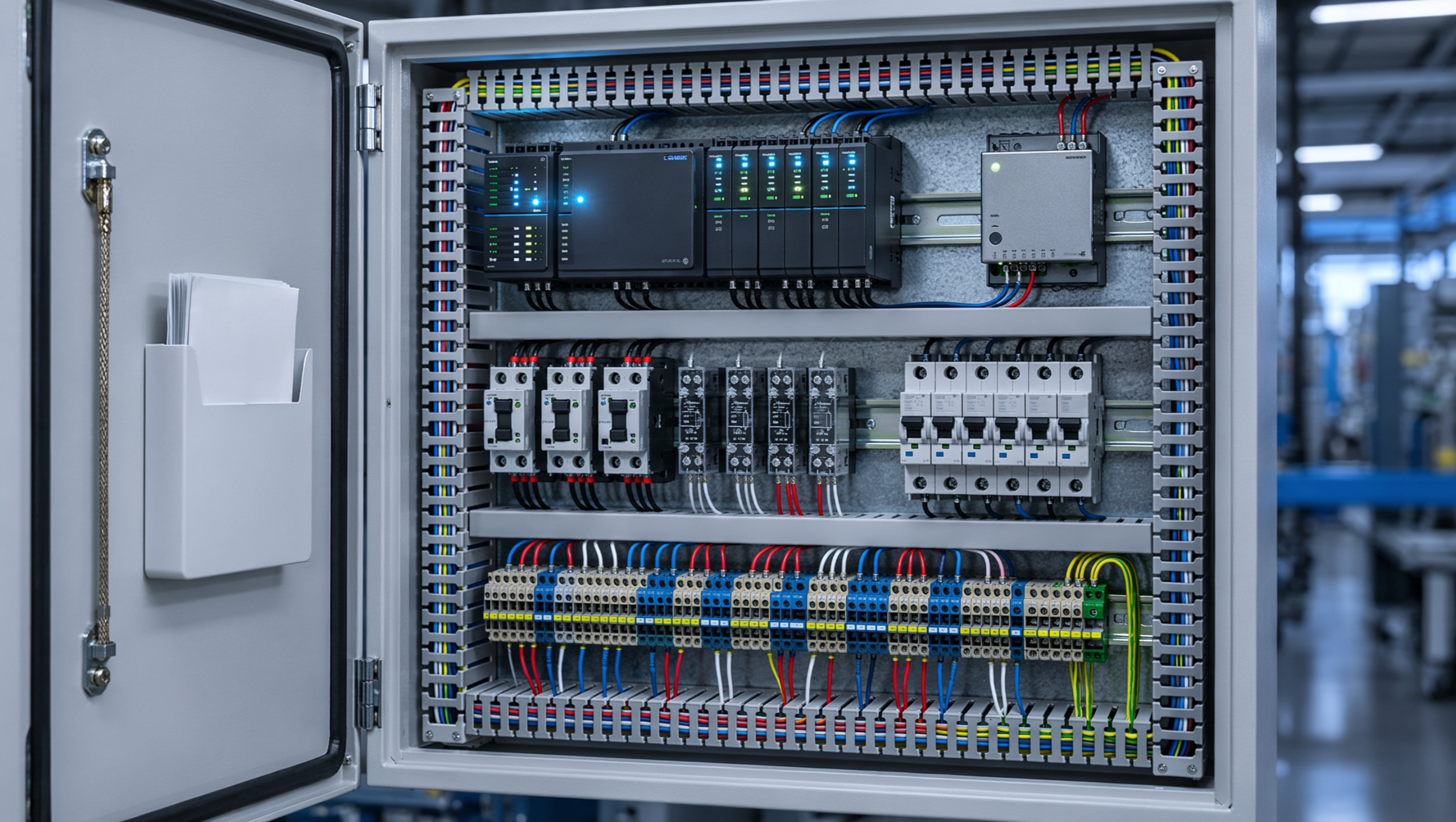
Getting a custom electrical control panel wrong can shut down an entire production line. In the United States, the electric control panel market was valued at $6.15 billion in 2025. Knowing what to specify, what standards apply and what to expect from a qualified builder makes the difference between a smooth project and a costly delay.
Introduction
Custom electrical control panels sit at the center of nearly every industrial operation. They manage motors, protect circuits, coordinate automation sequences and keep facilities running safely. Yet many buyers approach panel procurement without a clear picture of what drives cost, schedule and compliance.
This resource covers the questions engineers, operations leaders and procurement teams ask most often. It addresses components, design process, compliance standards and the real benefits of choosing a purpose-built panel over a standard unit.
Getting these decisions right early protects schedule, reduces field rework and supports safer commissioning. The stakes are high enough that a working knowledge of panel fundamentals pays off on every project.
What Is a Custom Electrical Control Panel?
A custom electrical control panel is an engineered assembly that manages, protects and automates industrial equipment. It's designed to meet specific operational requirements rather than a generic use case. According to TT Power Group, custom panels comply with standards such as UL 508A, IEC and CE, while standard panels arrive pre-configured for broad applications.
Demand for custom configurations is growing fast. Key drivers include:
Factory automation: Manufacturers need panels that match specific machine sequences and I/O counts.
Smart manufacturing: Industry 4.0 adoption requires panels with communications and monitoring built in.
Complex environments: Chemical processing, water treatment and cleanroom facilities have requirements no standard panel can meet.
Compliance pressure: Application-specific standards often require engineered documentation that off-the-shelf units don't provide.
According to Drives & Systems, over 70% of industrial customers now request application-specific panel configurations.
Core Components Inside a Custom Control Panel
A custom control panel brings together protection devices, control logic and operator interface hardware, with each layer serving a distinct function in the overall system. Protection devices guard against overcurrent events, control logic handles automation, and operator interface hardware gives personnel visibility into system status. Here is how the major component groups break down.
Circuit Breakers, Fuses, and Protection Devices
Circuit breakers and fuses protect equipment from overcurrent events. They're the first line of defense when a fault occurs. Per NFPA 70 (National Electrical Code), panels must include motor controllers, overload relays and fused disconnect switches on power circuits.
The panel's Short-Circuit Current Rating (SCCR) is determined by the lowest-rated component in the assembly, so component selection directly affects compliance.
PLCs, Relays, and Contactors
Programmable Logic Controllers (PLCs) handle the automation logic that makes a panel do more than just distribute power. The global PLC market was valued at USD $12.66 billion in 2025, according to Fortune Business Insights, with the manufacturing segment capturing 35% of market share.
Modular PLC configurations held 41.56% of global PLC market share in 2025, favored for expandable I/O and scalability. Relays and contactors work alongside PLCs to switch loads and isolate circuits under control system command.
HMIs, Drives, and Terminal Blocks
Human-Machine Interfaces (HMIs) give operators a window into the system. Touch-based HMI technology led the industrial HMI market with 61.8% market share in 2025, per Grand View Research / Mordor Intelligence. Variable frequency drives (VFDs) control motor speed and reduce energy consumption.
Terminal blocks organize field wiring connections and simplify troubleshooting. Together, these components form the operator-facing and field-connection layer of any custom panel.
How Custom Electrical Control Panels Are Designed and Built
Design and build execution determines whether a panel arrives field-ready or requires rework. The process moves through defined phases, and schedule depends heavily on complexity.
Design Considerations That Drive Customization
Panel design typically starts with CAD software such as AutoCAD Electrical or EPLAN. Engineers develop schematics, select components and size enclosures before fabrication begins. According to Prairie Electric / Automation Electric, a design-build approach, where procurement and software development run concurrently with fabrication, can compress project schedules by 20-30% versus sequential methods.
I/O count, environmental rating, power requirements and applicable standards all shape the final design package.
Testing and Quality Assurance Before Shipment
Factory Acceptance Testing (FAT) is the final gate before a panel ships. It's included in quoted lead times, not added on top. FAT confirms that wiring, logic, communications and protection devices all perform as specified. According to MCI Vernon Engineering, the full process runs from CAD design through component selection, enclosure fabrication, wiring and FAT.
Build times vary by scope. Here is the general breakdown:
Small panels (fewer than 50 I/O points): 4-6 weeks
Mid-range panels: 2-8 weeks depending on complexity
Large systems (exceeding 200 I/O points): 8-12 weeks
Per Uniregal, overall build times range from 2 to 12 weeks depending on scope.
Compliance Standards US Buyers Must Know
US buyers must navigate several overlapping standards. Knowing which applies to your panel, and confirming compliance before shipment, prevents costly delays at installation.
UL 508A vs NFPA 79: Which Applies to Your Panel?
UL 508A is the foundational North American product safety standard for industrial control panels operating at 1,000 volts or less. It was significantly revised on June 26, 2025, introducing new AC/DC control circuit voltage limits (120 Vac / 250 Vdc), relaxed Emergency Stop requirements and updated Class 2 circuit sourcing rules.
NFPA 79 applies specifically to electrical equipment on industrial machinery. Panels serving machine tools or automated equipment often require both.
NEMA Enclosure Ratings for US Environments
NEMA enclosure ratings define protection levels for US industrial environments. The ratings cover a range of conditions:
NEMA 1: Dry indoor spaces (approximately IP20)
NEMA 12: Indoor industrial environments with dust and dripping liquids (approximately IP54)
NEMA 4 and 4X: Hose-directed water and corrosion resistance (approximately IP66)
According to Viox, every NEMA rating meets or exceeds a corresponding IP code, but an IP-rated enclosure does not automatically satisfy the equivalent NEMA type.
Documentation Requirements for US Facilities
Facilities must be able to demonstrate compliance to inspectors and the Authority Having Jurisdiction (AHJ). Under NFPA 70 Article 409, panels must display available fault current at input terminals, the date of the calculation and the panel's SCCR in an accessible location on the enclosure, as required by Industrial Monitor Direct.
Accurate as-built drawings, wiring diagrams and component datasheets support this requirement.
Role of the Authority Having Jurisdiction (AHJ)
The AHJ is the local official or inspector who approves electrical installations. Their interpretation of applicable standards can vary by jurisdiction. Confirming certification requirements with the AHJ during design, rather than after fabrication, prevents late-stage changes.
Outsourced UL certification, when a panel shop lacks in-house UL 508A capability, adds 2-3 weeks to lead times and introduces supply chain risk, per Uniregal.
Benefits of Choosing a Custom Panel Over a Standard Unit
Standard panels compromise somewhere. Custom panels don't. The performance and reliability advantages are well documented.
Key benefits include:
Energy savings: Custom panels incorporating VFDs reduce motor energy usage by 20-60%, per ASG Power.
Reduced downtime: A 2025 study on PLC/SCADA-based smart energy management demonstrated a 63% reduction in unplanned downtime in manufacturing plants that deployed advanced custom control systems, per ASG Power / Research Gate.
Cost control: According to MIS Controls, 61% of manufacturers suffered unplanned downtime in the past year, costing the global sector up to $852 million every week.
Compliance alignment: Custom panels are engineered to meet the exact standards required by the application and AHJ, reducing compliance surprises at inspection.
Scalability: Modular architectures allow I/O expansion and component upgrades without replacing the entire assembly.
Documented performance: A pharmaceutical plant case study showed custom panels reduced downtime from 10 hours monthly to zero and saved $50,000 annually, per Berakah Solutions.
Conclusion
Custom electrical control panels are not a premium option reserved for complex projects. They're the practical choice whenever a facility has specific operational requirements, compliance obligations or performance targets that a standard unit can't meet. The combination of engineered design, in-house testing and standards-driven documentation supports safer installation, smoother commissioning and long-term reliability.
For US buyers, the path to a successful panel project starts with clear specifications, early compliance alignment and a qualified manufacturing partner. Getting those fundamentals right reduces field risk, protects schedule and supports the kind of consistent uptime that modern industrial operations depend on.
Frequently Asked Questions
How much does a custom electrical control panel cost in the United States?
Custom panel pricing in the United States ranges from $500 to $2,000 for small basic panels, $2,000 to $10,000 for medium industrial panels and $10,000 or more for large custom systems. Complex multi-section assemblies for industrial applications can reach six figures.
According to Onesto EP, scope, component selection and certification requirements all influence final cost. Getting a detailed specification locked in early helps control budget surprises.
Which industries in the United States use custom control panels most?
Industrial automation and process control represents an estimated 42% share of end-use demand for control panels in the United States, per IndexBox. Chemical processing, water treatment, pharmaceutical manufacturing and cleanroom infrastructure are among the highest-demand segments. EV charging infrastructure is a fast-growing application, with over 125,000 control panel units required globally in 2024 alone.
What is SCCR and why does it affect panel compliance?
Short-Circuit Current Rating (SCCR) is determined by the lowest-rated component in the entire panel assembly. NFPA 70 requires panels to display SCCR in an easily accessible location on the enclosure. Undersized SCCR is one of the most common and most dangerous compliance gaps found during AHJ inspections.
Confirming SCCR during the design phase, before fabrication begins, avoids costly component substitutions and schedule delays.
How do custom panels compare to standard panels for long-term performance?
Custom panels are engineered to match the exact load profile, environment and control logic of the application. Standard panels are pre-configured for generic use and often require field modifications to fit.
The 2025 UL 508A revision introduced updated voltage limits and Emergency Stop requirements that affect panels currently in design. Custom builds can incorporate these changes from the outset, while standard units may require retrofits to maintain compliance.
How long does it take to implement a custom electrical control panel project?
Lead times depend on complexity. Small relay control boxes typically take 1-2 weeks. Standard PLC panels run 2-4 weeks. Large integrated control systems require 8-12 weeks or more, per CCS Automation.
Component shortages for embedded controllers are running 20-40 week lead times in 2025-2026, making early procurement planning essential. Factory Acceptance Testing is included in these lead times, not added on top.
