
What Is an E-House? Modular Power for Utility, Industrial and Renewable Projects
November 9th, 2026
6 min read
By ASG Power
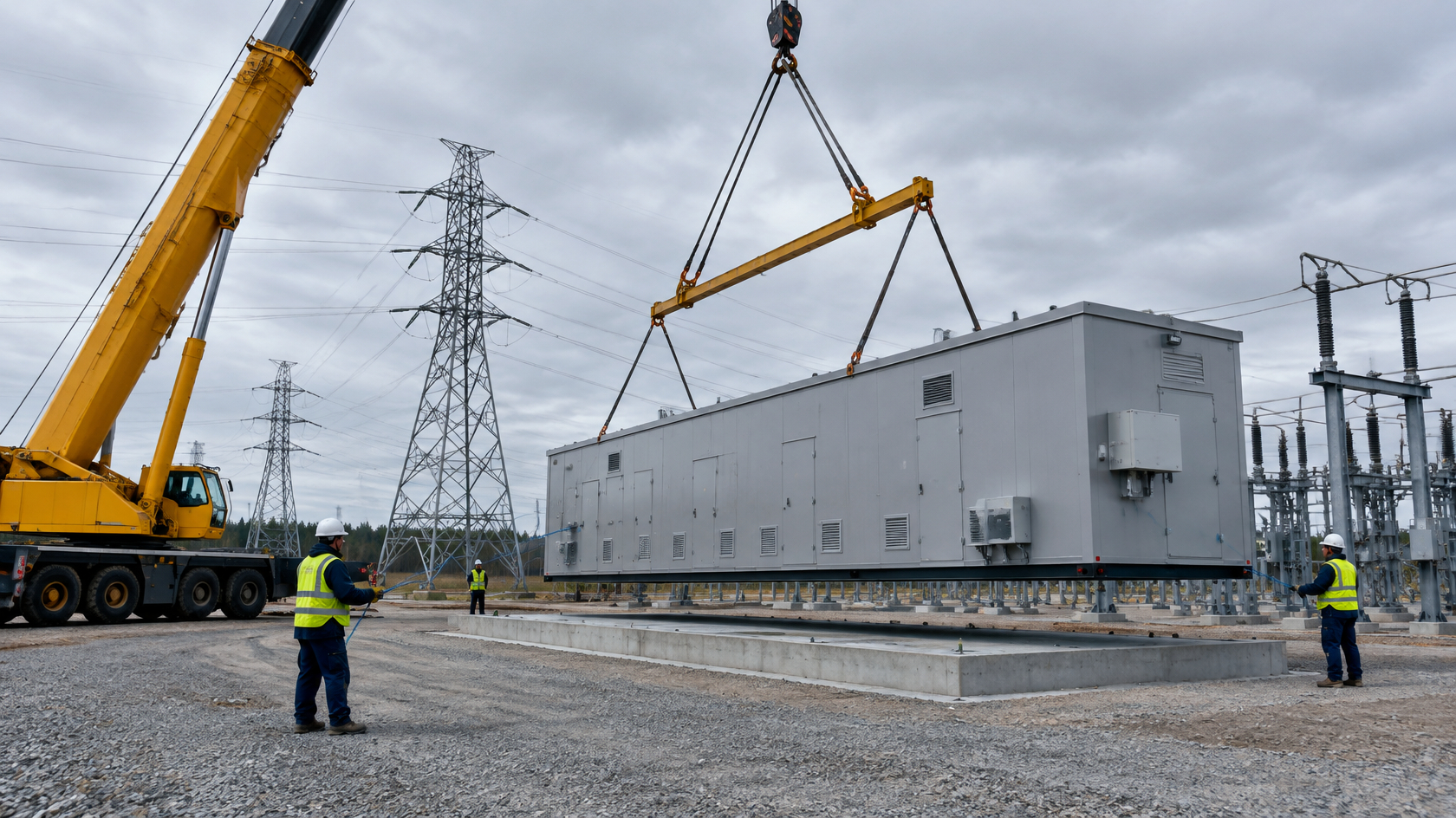
Power projects stall when electrical infrastructure can't keep pace with construction timelines. E-Houses solve that problem by shifting complex assembly into a controlled factory environment. The result is faster deployment, fewer field surprises and better compliance from day one.
Introduction
Electrical infrastructure has long been one of the slowest parts of any major project. Conventional substations require months of civil work, sequential wiring and on-site commissioning before a single megawatt flows. That pace no longer fits the demands of utility-scale solar, battery storage, mining or industrial expansion.
An E-House changes that equation. It's a factory-built, walk-in modular enclosure that integrates switchgear, transformers, controls and communications before it ever reaches the site. Equipment arrives pre-wired, pre-tested and ready for connection.
Understanding what E-Houses deliver, and where they fit, helps project teams make smarter decisions about schedule, cost and field risk. The stakes are real: grid investment needs to grow by roughly 50% through 2030 to meet global electricity demand, according to IEA data cited by ZN-MEOX.
What Is an E-House in Electrical Terms?
An E-House (Electrical House) is a prefabricated, transportable structure that integrates electrical and control equipment inside a single, factory-built enclosure. It connects, protects and distributes power across utility, industrial and renewable assets, arriving on-site as a tested unit ready for energization.
Key components typically found inside an E-House include:
- Medium-voltage switchgear: Controls and protects high-power distribution circuits
- Transformers: Step voltage up or down to match load requirements
- Motor control centers (MCCs): Manage motors and driven equipment
- Busbars and protection systems: Distribute current safely within the enclosure
- Automation and communications: Support SCADA, IEC 61850 and remote monitoring
- HVAC systems: Maintain safe operating temperatures for sensitive equipment
- UPS and power supplies: Protect controls during grid disturbances
According to Eaton, typical E-House dimensions range from 3m x 2.5m up to 18m x 4m or larger. The global E-House market was valued at approximately USD 1.71 billion in 2024, growing at a projected CAGR of 7.11% through 2032, per Novatrends Market Intelligence.
E-House vs. Conventional On-Site Construction
Power projects move more smoothly when equipment is connected safely, controlled reliably and delivered efficiently. E-Houses make that possible by replacing sequential site work with parallel factory manufacturing.
Schedule and Cost Comparison
A conventional substation can take 12 to 24 months to complete. An E-House can be manufactured, tested and delivered within 6 to 12 weeks, with on-site installation completed in just 2 to 5 days, per DOHO Electric.
Siemens benchmarks show E-Houses can cut overall lead time by up to 50% and reduce costs by up to 20% through standardization and reduced on-site presence. Total installed cost runs 15 to 20% lower than conventional builds, with savings reaching 30% on remote or time-pressured projects.
Quality and Compliance Control
Factory conditions allow rigorous pre-shipment testing that field environments can't match. Insulation resistance checks, protection relay settings, HVAC functional tests and SCADA communication verification all happen before the unit ships.
E-Houses comply with core IEC standards including IEC 62271-202 for prefabricated substations, IEC 61439 for low-voltage assemblies and IEC 60529 for enclosure protection. ABB notes a design lifetime of 30 years when units are properly configured, per their E-House Presentation.
E-House Applications Across Utility, Industrial and Renewable Projects
E-Houses serve a wide range of sectors. Utilities represent the largest segment, accounting for approximately 49 to 53% of global revenue in 2025, per Straits Research. Industrial applications follow, with renewable energy among the fastest-growing segments.
Power Generation and Grid Infrastructure
Utilities rely on E-Houses to accelerate substation deployment without the delays of conventional civil construction. A real example: Eaton delivered a major substation upgrade for Jemez Mountains Electric Cooperative in Blanco, New Mexico, completing the project two months after breaking ground, per an Eaton case study.
The on-site team installed the unit within days rather than weeks because factory wiring and testing were already complete. Data centers are also driving demand, with ABB supplying prefabricated eHouse units for grid stabilization at multiple U.S. facilities, per ABB.
Renewable Energy and Energy Storage
Renewable energy integration accounted for approximately 35% of containerized substation demand in 2025, with about 38% of new E-House projects commissioned between 2023 and 2025 tied to solar and wind applications, per SNS Insider.
Battery energy storage is growing fast. The U.S. installed a record 18.9 GW of battery storage in 2025, a 52% increase over 2024, according to SEIA. Every one of those projects requires modular power infrastructure for safe grid integration, making E-Houses a standard tool for BESS deployment.
Why Mining and Oil and Gas Projects Rely on E-Houses
Remote sites, harsh conditions and compressed timelines make conventional electrical construction impractical. E-Houses solve all three problems by arriving ready to energize, with no dependence on local trade availability or extended civil programs.
Mining Power Distribution
Mining represents approximately 12% of global E-House demand, valued at around USD 203.6 million in 2025 and forecast to be the fastest-growing application segment at roughly 8.32% CAGR through 2035, per Industry Research Biz.
E-House adoption in mining is reducing average site electrical installation timelines from 18 to 24 months down to 6 to 9 months. Becker Mining USA reports clients achieve an average 60% reduction in commissioning time versus traditional builds, per Becker Mining USA. In one Nevada case study, an additional E-House was delivered and installed in less than two weeks.
Oil and Gas Electrical Systems
Oil and gas represents approximately 18% of global E-House demand, around USD 305.5 million, growing at roughly 6.95% CAGR, per Industry Research Biz. Offshore and onshore producers both benefit from modular electrical systems that can be factory-tested before deployment to remote or hazardous locations.
ABB delivered 4,000 square meters of E-Houses for the Satah al-Razboot offshore oil field in the UAE, an USD 80 million order housing LV/MV switchgear, MCCs, VFDs and an Electrical Control Monitoring System, per ABB. Producers in the Permian Basin report 25% lower completion costs after adopting electric-fracturing fleets powered by E-Houses, per MEOX.
Key Advantages of E-House Solutions
E-Houses consistently outperform conventional builds on schedule, cost and quality. The global market is forecast to reach USD 3.10 billion by 2035, per SNS Insider via Globe Newswire, reflecting strong adoption across every major sector.
The core advantages include:
- Faster deployment: Mobile E-Houses reach full operational status in 3 to 5 days from initial site preparation, per Eaton MITS
- Reduced onsite labor: On-site construction work drops by 60 to 80%, with civil engineering scope falling by over 70%, per Siemens
- Lower total installed cost: Savings of 15 to 20% are typical, with remote projects reaching 30%, per DOHO Electric
- Relocatability: Skid- or wheel-mounted units can be repositioned without full disassembly, supporting phased projects and temporary power needs
- Digital integration: Approximately 42% of new E-House models introduced globally in 2024 included SCADA digital systems for remote management, per DataIntelo
- Long service life: Properly configured units are designed for a 30-year operational lifetime
"A modular substation delivered as a ready-to-install eHouse integrates switchgear, transformers, and control systems in a single, transportable steel container. Because the unit is pre-wired and pre-tested, on-site personnel have significantly less installation time." - ABB
Conclusion
E-Houses have moved from a niche option to a standard approach across utility, industrial and renewable projects. The combination of factory quality, compressed schedules and reduced field labor addresses the pressures that define modern electrical infrastructure work. When sites are remote, timelines are tight or compliance requirements are strict, modular delivery shifts risk from the field into a controlled manufacturing environment.
For teams evaluating their next power project, the case for E-Houses is grounded in real outcomes across mining, oil and gas, grid infrastructure and energy storage. Getting the design, build and delivery process right from the start is what separates projects that commission on time from those that don't.
Frequently Asked Questions
How much does an E-House cost compared to conventional construction in the United States?
Total installed cost for an E-House typically runs 15 to 20% lower than conventional site-built substations, with savings reaching 30% on remote or time-pressured U.S. projects. On-site labor requirements fall sharply and civil engineering scope drops significantly. A 2026 comparison from ICCE puts the total E-House project cycle at 6 to 10 weeks versus 6 to 18 months for conventional builds.
How are E-Houses used in United States renewable energy and battery storage projects?
U.S. battery storage installations hit a record 57.6 GWh in 2025, per SEIA, and every project requires modular power infrastructure for grid integration. E-Houses support both utility-scale solar and BESS interconnection by delivering pre-tested switchgear, transformers and controls directly to the project site. Approximately 420 renewable energy projects between 2022 and 2024 used E-Houses to deliver power within six months, compared to 12 to 18 months conventionally, per DataIntelo.
What is the difference between an E-House and a compact substation?
An E-House is a walk-in modular enclosure large enough for personnel to operate and maintain equipment inside. Compact substations are typically non-walk-in units. E-House dimensions range from 3m x 2.5m to 18m x 4m or larger, with transformer capacity running from 500 kVA to 5 MVA and voltage coverage extending to 40.5 kV medium-voltage and 690 V low-voltage, per Greening Group.
How does an E-House compare to traditional on-site electrical construction for schedule?
An E-House can be manufactured and delivered in 6 to 12 weeks, with on-site installation taking 2 to 5 days. Traditional substations require 12 to 24 months due to sequential civil works, wiring and commissioning. Siemens installed approximately 150 power distribution E-Houses across 20 countries with more than 300 modules in the last three to four years, per Siemens, demonstrating the scale at which modular delivery now operates.
What does implementing an E-House require in terms of site preparation?
Site preparation for an E-House is minimal compared to conventional construction. Teams typically need a prepared foundation or skid pad, crane access for positioning and cable termination points. Renewable energy developers now place orders 9 to 12 months ahead of site preparation to secure factory slots, reflecting transformer lead times that reached 52 weeks in 2025, per Grand View Research. Early procurement planning is the most critical implementation step.
