
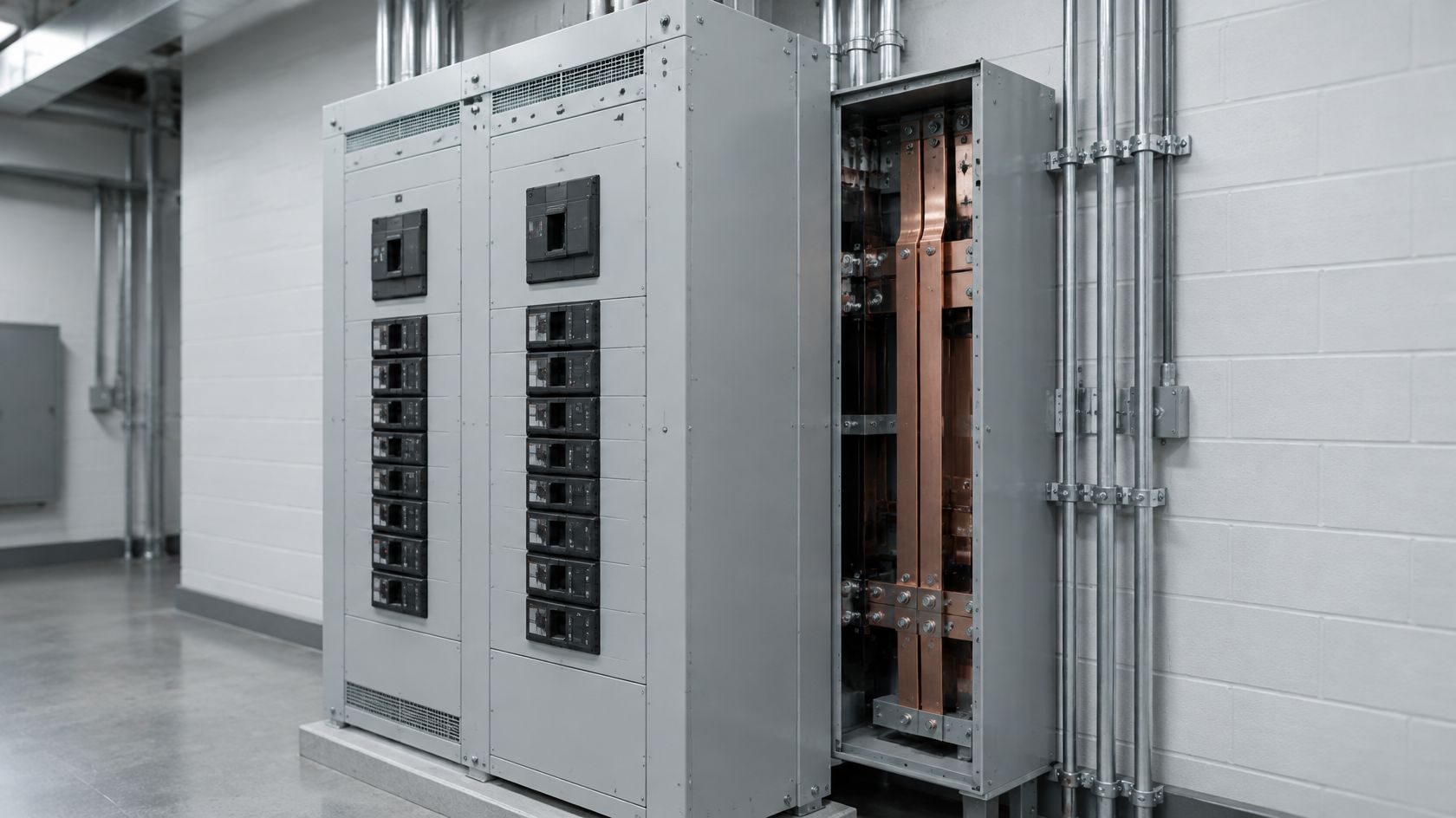
Specifying the wrong equipment type can delay a project by months and create serious safety risk. Knowing the difference between switchboards and switchgear is one of the most practical decisions an electrical project team can make.
Introduction
Switchboards and switchgear both distribute power and protect electrical systems. They're often confused because they look similar and serve overlapping roles. But they're governed by different standards, rated for different fault conditions, and built for very different applications.
Choosing the wrong one doesn't just affect budget. It affects safety, compliance, and long-term uptime. A switchboard installed where switchgear is required can fail to interrupt a fault current, creating arc flash risk and potential code violations.
Getting this decision right matters more in 2026 than it did five years ago. Lead times are stretching well past a year for some equipment types, and pricing has risen sharply. Understanding what each piece of equipment actually does helps teams specify correctly from the start.
What Is a Switchboard?
According to ECM Web / NEC Article 408, the National Electrical Code (NEC) defines a switchboard as "a large single panel, frame, or assembly of panels on which are mounted switches, overcurrent and other protective devices, buses, and usually instruments." It is not intended to be installed in a cabinet.
Switchboards sit between panelboards and switchgear in the distribution hierarchy. Key specifications include:
Standards: Governed by UL 891 and NEMA PB-2
Voltage range: Up to 600V
Ampacity: Bussing typically rated from 1,200A to 5,000A
Interrupting ratings: 25 to 100 kAIC
Breaker type: Fixed or plug-in molded case circuit breakers (MCCBs) or insulated case circuit breakers (ICCBs), rated at 80% continuous current
Maintenance: Requires full de-energization for any component service
What Is Switchgear?
Switchgear is a coordinated assembly of switching, interrupting, protection, metering, and control equipment used to distribute power and isolate abnormal conditions. Per ECM Web / NEC Article 100, all switchgear subject to NEC requirements is completely metal-enclosed on all sides and top. That enclosure is a defining structural difference from switchboards.
"The U.S. switchgear market reached USD 19 billion in 2025, driven by energy infrastructure modernization and growing demand from data centers and industrial facilities." - Global Market Insights
Main Components of Switchgear
Switchgear is not a single device. It's a system. Common components include:
Draw-out power circuit breakers: Rated at 100% continuous current, removable without de-energizing adjacent equipment
Busbars: Compartmentalized and isolated to reduce arc flash exposure
Protective relays: Monitor current, voltage, and frequency to trigger isolation
Metering and instrumentation: Track load and support energy management
Control wiring and interlocks: Coordinate switching sequences safely
This system-level design is what allows live maintenance and supports mission-critical uptime requirements.
Three Types of Switchgear Used in US Facilities
US facilities use three types of switchgear, classified by voltage level: low voltage, medium voltage, and high voltage. Each type serves a distinct role in the power distribution chain, handling different fault current levels and operational demands to keep electrical systems running safely and efficiently.
Low-voltage (LV) switchgear: Operates up to 1,000V (most U.S. installations at 600V or below), governed by UL 1558 and ANSI/IEEE C37.20.1, with interrupting ratings up to 200 kAIC. Per Global Market Insights, the global LV switchgear market was valued at USD 44.5 billion in 2025
Medium-voltage (MV) switchgear: Operates from 1 kV to 35 kV. A single automotive assembly plant may use 20 to 30 MV assemblies managing robotic lines and conveyor systems. The U.S. MV switchgear market was approximately USD 7.35 billion in 2025
High-voltage (HV) switchgear: Operates above 35 kV for long-distance transmission. Gas-insulated switchgear (GIS) held 55.4% of the HV segment in 2025. California banned new SF6 GIS equipment under 38 kV starting January 1, 2025
Switchboards vs Switchgear: Key Differences
The gap between switchboards and switchgear goes beyond voltage. Construction standards, fault performance, and maintenance access all differ significantly. According to ABB, switchgear costs 2 to 3 times more than a switchboard at equivalent amperage, but that premium reflects real performance differences.
Voltage and Interrupting Ratings
Switchboards top out at 600V. Switchgear handles systems from low voltage up to 350 kV at the high end. Fault withstand is an equally important distinction. Per Eaton, switchgear withstands fault currents for up to 30 cycles tested at 15% power factor. Switchboards are tested at 20% power factor for only 3 cycles. That's a tenfold difference in fault tolerance.
Enclosure and Construction Standards
Switchgear must pass seven required production tests before leaving the factory. Switchboards require only three, per Maverick Power. Switchgear features compartmentalized busbar partitions and can carry arc-resistant ratings per IEEE C37.20.7-2024. Switchboards use an open busbar design with no accepted arc-resistant standard. That difference matters significantly in facilities where arc flash risk is a primary concern.
US Cost Ranges: Switchboards vs Switchgear
Pricing varies widely by voltage level, ampacity, and project scope. The Producer Price Index for switchgear and switchboard apparatus manufacturing reached 441.30 in August 2025, up 13.6% year-over-year per YCharts / BLS. Since January 2020, the index has risen 89.4% cumulatively.
Typical equipment cost ranges include:
Residential switchboard (100-200A): $39 to $230 per unit; full 200A upgrade installed runs $4,500 to $12,000
Commercial switchboard (400A to 4,000A): $15,000 to $200,000 or more depending on ampacity
LV switchgear (400-630A, UL 1558): $3,200 to $9,800; complete projects reach $250,000 to $1.2 million
MV switchgear (5-15kV): Equipment-only starts around $90,000; full replacement projects run $150,000 to $400,000
HV switchgear (15kV-38kV+): Complete installations range from $250,000 to $750,000 or more
Factors That Drive Cost Up
Several variables push switchgear and switchboard costs above baseline estimates:
Arc-resistant ratings: Adds engineering complexity and material cost
Custom enclosure requirements: Seismic ratings, NEMA 4X, or hazardous-location specs
Extended lead times: Medium-voltage switchgear now runs 52 to 80 weeks as of 2026, with data-center-spec gear approaching 2 to 3 years
Factory acceptance testing: Required for mission-critical applications
Documentation packages: As-built drawings, relay settings, and coordination studies add engineering hours
When to Choose a Switchboard vs Switchgear
Choosing between a switchboard and switchgear comes down to four key factors: voltage, fault current, maintenance requirements, and facility criticality. Evaluating each factor against your specific application will guide the right decision. A practical framework for working through those considerations follows below.
Choose a switchboard when the application meets these conditions:
The system operates at 600V or below
Load requirements don't exceed 5,000A
Budget is a primary constraint
The facility can tolerate planned shutdowns for maintenance
The application is a standard commercial building, office, school, or light industrial space
Choose switchgear when the application meets these conditions:
Voltages exceed 600V (MV is mandatory above 1 kV per IEEE C37.20.2)
Calculated fault current exceeds the switchboard's available interrupting capacity (a mandatory NEC safety requirement)
The facility is mission-critical: hospitals, data centers, or utilities requiring live maintenance
Arc flash risk is a primary concern, given that NFPA data shows 5 to 10 arc flash explosions occur daily in the U.S. and switchgear's compartmentalized design significantly reduces that risk compared to switchboards' open busbar
"18% of U.S. hospitals are actively constructing switchgear or transformer projects, with some ordering equipment before finalizing design drawings to manage lead-time risk." - ASHE/HFM
Conclusion
Switchboards and switchgear are not interchangeable. They're engineered for different fault conditions, maintained differently, and governed by different standards. Choosing between them requires honest assessment of voltage requirements, fault current levels, maintenance access needs, and how much downtime the facility can absorb.
For most standard commercial applications, switchboards remain a cost-effective and code-compliant solution. For mission-critical facilities, high-fault environments, or systems operating above 600V, switchgear is the appropriate choice. Getting the specification right early avoids costly redesigns, compliance problems, and schedule delays that compound quickly in today's supply environment.
Frequently Asked Questions
How much does switchgear cost compared to a switchboard in the United States?
Switchgear typically costs 2 to 3 times more than a switchboard at equivalent amperage. For U.S. projects, a 400A commercial switchboard runs roughly $15,000 to $30,000 installed, while a comparable LV switchgear lineup can reach $250,000 or more for a full main-service project. The premium reflects higher construction standards, more rigorous factory testing, and draw-out breaker designs that support live maintenance.
What NEC articles govern switchboards and switchgear in the United States?
The 2026 NEC expanded field-marking requirements under Section 408.6, adding a five-item list covering available fault current and short-circuit current ratings for switchboards, switchgear, and panelboards in commercial and industrial buildings. Switchboards and switchgear may be reconditioned under the NEC; panelboards may not. These distinctions matter during AHJ review and commissioning inspections.
What is the difference in fault withstand between switchboards and switchgear?
Switchgear withstands fault currents for up to 30 cycles tested at 15% power factor. Switchboards are tested at 20% power factor for only 3 cycles. Per IEEE-493 data cited by Maverick Power, UL 891 switchboard failure rates run 156% higher than UL 1558 switchgear. Switchgear also requires seven production tests before shipment; switchboards require three.
Can a switchboard be upgraded to switchgear later?
Switchboards and switchgear are distinct assemblies with different enclosure designs, breaker types, and bus configurations. They can't be converted. Upgrading typically means replacing the entire assembly. Switchgear modernization (swapping breakers only rather than full replacement) can deliver roughly 40% cost savings and extend asset life by 15 to 30 years, per ABB analysis, while cutting project timelines significantly.
How long does switchgear installation typically take from order to commissioning?
Lead times are the biggest scheduling risk in 2026. Medium-voltage switchgear currently runs 52 to 80 weeks from order. Data-center-specification MV gear is approaching 2 to 3 years at peak-demand manufacturers. Properly maintained MV switchgear operates 20 to 30 years per IEEE data, so early procurement planning pays long-term dividends. Teams on mission-critical projects are increasingly ordering equipment before design drawings are finalized to protect schedule.
