Electrical hazards kill or injure workers every day across American job sites. In 2024 alone, ESFI recorded 130 workplace electrical fatalities in the United States. Knowing your power safety equipment is the difference between a close call and a fatality.
Introduction
Power safety equipment covers every device, garment and tool designed to protect workers from electrical shock, arc flash, fire and hazardous energy release. It spans personal protective equipment, circuit protection hardware and energy control procedures. Together, these layers form a system, not a checklist.
The stakes are rising. Non-fatal electrical injuries jumped sharply in recent years, and over 74% of electrical fatalities between 2011 and 2024 occurred in non-electrical occupations, according to ESFI. That means the risk extends well beyond licensed electricians. The right gear, matched to the right hazard, keeps people working safely and keeps operations running.
What Power Safety Equipment Actually Covers
Power safety equipment is any product or system that reduces the risk of electrical injury, fire or death. It is governed primarily by OSHA 29 CFR 1910.137 and NFPA 70E. The global electrical safety products market was valued at USD $27 billion in 2024, projected to reach $46.9 billion by 2034, per Global Market Insights.
Coverage falls into three distinct protection areas:
- Insulating PPE: Rubber gloves, sleeves, mats and boots that block electrical current from reaching the body
- Arc-rated PPE: Flame-resistant clothing, hoods and face shields that absorb and dissipate thermal energy from arc flash events
- Protective accessories: Insulated tools, lockout/tagout kits and safety signage that control hazardous energy at the source
The 5 Core Categories of Power Safety Equipment
The five core categories of power safety equipment are shock protection, arc flash protection, lockout/tagout devices, circuit protection devices, and grounding equipment. Each category targets a specific failure mode and carries its own standard, forming the foundation of any complete electrical safety program.
The core categories include:
- Arc-rated clothing: The electrical safety PPE market was valued at USD $20.6 billion in 2024, with arc-rated and flame-resistant garments leading all segments, per Global Market Insights
- Insulating gloves: Hand protection generated USD $6.5 billion in 2024, the largest PPE sub-segment; gloves are classed from Class 00 through Class 4 under ASTM D120
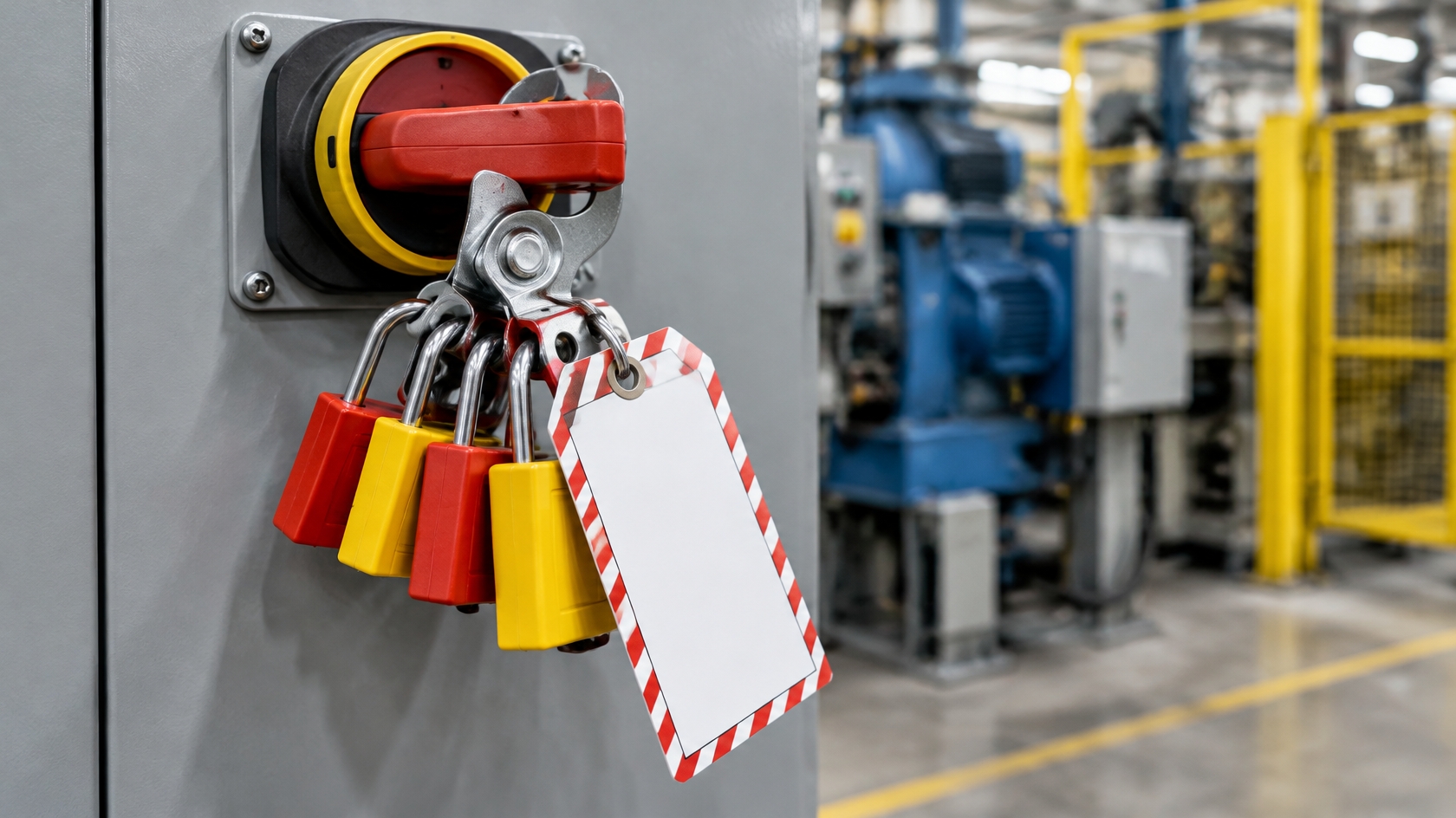
- Lockout/tagout (LOTO) equipment: Padlocks, hasps, tags and energy-isolating devices used to control hazardous energy during maintenance
- Insulated tools: Tools meeting ASTM F1505 and IEC 60900 standards, rated to withstand voltages up to 1,000V on energized circuits, per Mann Supply
- Voltage detectors and testers: Non-contact testers that verify de-energization before any worker contacts a conductor, as required by OSHA guidance
Shock vs. Arc Flash: Matching Gear to the Right Hazard
Matching gear to the right hazard requires understanding that electric shock and arc flash are two distinct risks that demand different equipment. Mixing them up leaves workers exposed. Shock hazards call for insulating gloves and barriers, while arc flash hazards require flame-resistant clothing and face protection rated to the incident energy level.
Rubber Insulating Gloves by Voltage Class
Shock protection starts with voltage-rated insulating gloves. OSHA mandates their use any time nominal voltage reaches 50V or greater. Classes run from Class 00 (rated to 500V) through Class 4 (rated to 36,000V) under ASTM D120 and OSHA 1910.137(a).
OSHA also requires leather protector gloves worn over every rubber insulating glove class. According to CreativeSafety/OSHA, insulated gloves can reduce electric shock risk by 80% on contact with live wires.
The Four Arc Flash PPE Categories (NFPA 70E 2024)
Arc flash is the explosive release of thermal energy when a fault creates an electrical arc. Temperatures can exceed 35,000°F, per Tyndale USA. NFPA 70E 2024 defines four PPE categories based on incident energy measured in cal/cm²:
- Category 1: 4 cal/cm² minimum, FR shirt and pants
- Category 2: 8 cal/cm² minimum, FR clothing plus face shield
- Category 3: 25 cal/cm² minimum, full arc flash suit
- Category 4: 40 cal/cm² minimum, multi-layer arc flash suit
"Approximately 2,000 workers are sent to burn units annually due to arc flash injuries, and arc flash represents one of the most severe electrical hazards in the workplace." - OSHA
Five Basic Safety Rules for Using Power Tools
OSHA Publication 3080 establishes five foundational safety rules that apply to every powered tool on every job site. Following them is essential because power tools account for roughly 400,000 emergency room visits annually in the United States, per Tool Troopers/OSHA.
Lockout/Tagout: The Equipment It Requires
Lockout/tagout is the most critical energy control procedure in any facility. OSHA estimates proper LOTO compliance prevents approximately 120 fatalities and 50,000 injuries annually. Despite that, LOTO (1910.147) ranked as the 4th most-cited OSHA violation in FY2025, with 2,177 citations and roughly $21.9 million in penalties.
A complete LOTO kit requires specific hardware to be effective:
- Energy-isolating devices: Circuit breakers, disconnect switches and valve lockouts that physically block energy flow
- Lockout padlocks: Individually keyed locks assigned to each authorized worker
- Hasps: Multi-lock devices that allow multiple workers to secure one isolation point simultaneously
- Danger tags: Durable labels that identify who applied the lockout and when
- Lockout stations: Centralized boards that store and organize all LOTO hardware for fast access
Circuit Protection Devices: The Engineering Safety Layer
Circuit protection devices stop electrical faults before they reach workers by operating independently of human action, making them a critical backstop in any power safety program. Unlike PPE, which relies on worker behavior, these engineering controls respond automatically, providing a reliable layer of protection that functions even when other safeguards fail.
GFCI vs. AFCI: Which Device Goes Where
A ground fault circuit interrupter (GFCI) protects people from electric shock. It trips in approximately 1/40 of a second when it detects a current imbalance of just 4 to 6 milliamps. Since GFCIs entered homes, electrocutions have dropped 81%, per ESFI. GFCIs are required in wet locations: bathrooms, kitchens, garages and outdoor circuits.
An arc fault circuit interrupter (AFCI) protects property from electrical fires. It detects dangerous arcing that a standard breaker misses. The CPSC estimates 50% of home electrical fires could be prevented with proper AFCI protection, per ESFI's 2024 AFCI Performance Survey.
Under the 2023 National Electrical Code (Section 210.12), AFCI protection is now required for virtually every 15A and 20A general-purpose circuit in new residential construction. The two devices serve different functions and are not interchangeable.
"Since GFCIs were introduced, electrocutions in the home have dropped 81%, demonstrating the measurable impact of engineering controls on electrical fatality rates." - ESFI
Conclusion
Power safety equipment works as a system. Shock hazards require insulating gear matched to voltage class. Arc flash hazards require arc-rated clothing matched to incident energy. Circuit protection devices and LOTO procedures add engineering and procedural layers that PPE alone cannot replace.
For manufacturing teams and facility operators, the path forward is clear. Assess the hazards present, select equipment that meets the governing standard for each hazard and train every worker who may encounter energized equipment. Getting these fundamentals right reduces injuries, controls costs and keeps operations moving.
Frequently Asked Questions
How much does power safety equipment cost in the United States?
OSHA penalties for power tool safety violations can reach $16,550 per serious violation and up to $165,514 per willful or repeated violation, per EMC Insurance/OSHA. By contrast, a complete written safety program with training typically costs $3,000 to $5,000 total.
Investing in the right PPE and circuit protection hardware costs a fraction of a single OSHA citation or workers' compensation claim.
How common are electrical injuries in the United States?
Approximately 1.2 million people sustain electrical accident-related injuries worldwide each year. In the U.S., non-fatal electrical injuries involving days away from work totaled 5,180 in the 2023 to 2024 period combined, a 59% increase over the prior two-year period, according to ESFI/BLS. The rise signals that existing protection programs are not keeping pace with current exposure levels.
What does NFPA 70E require for arc flash risk assessment?
The 2024 edition of NFPA 70E made risk assessment hierarchy documentation mandatory for every task, per Tyndale USA. Employers can no longer default to a PPE category without first documenting why de-energization is not feasible. PPE is now explicitly the lowest-priority control in the hierarchy. Assessments must be reviewed and updated whenever equipment or tasks change.
Can arc flash occur at low voltages, and how does it compare to shock risk?
Yes. OSHA's 2024 guidance specifically notes that serious arc flash hazards can occur at voltages as low as 120V, per OSHA Publication 4472. Arc flash accounts for 34 to 55% of all work-related electrical burn hospitalizations, making it the dominant injury hazard even though electric shock causes the majority of electrical fatalities. Both hazards require separate, properly matched PPE.
What is the first step to implementing a power safety equipment program?
Start with a hazard assessment. OSHA's five basic power tool safety rules, from OSHA Publication 3080, require examining each tool for damage before use and matching PPE to the specific task.
Only 55% of U.S. manufacturing firms have documented LOTO programs, per Safety Evolution/OSHA. Documenting hazards, selecting the right equipment category and training workers are the three steps that build a compliant, effective program.
