
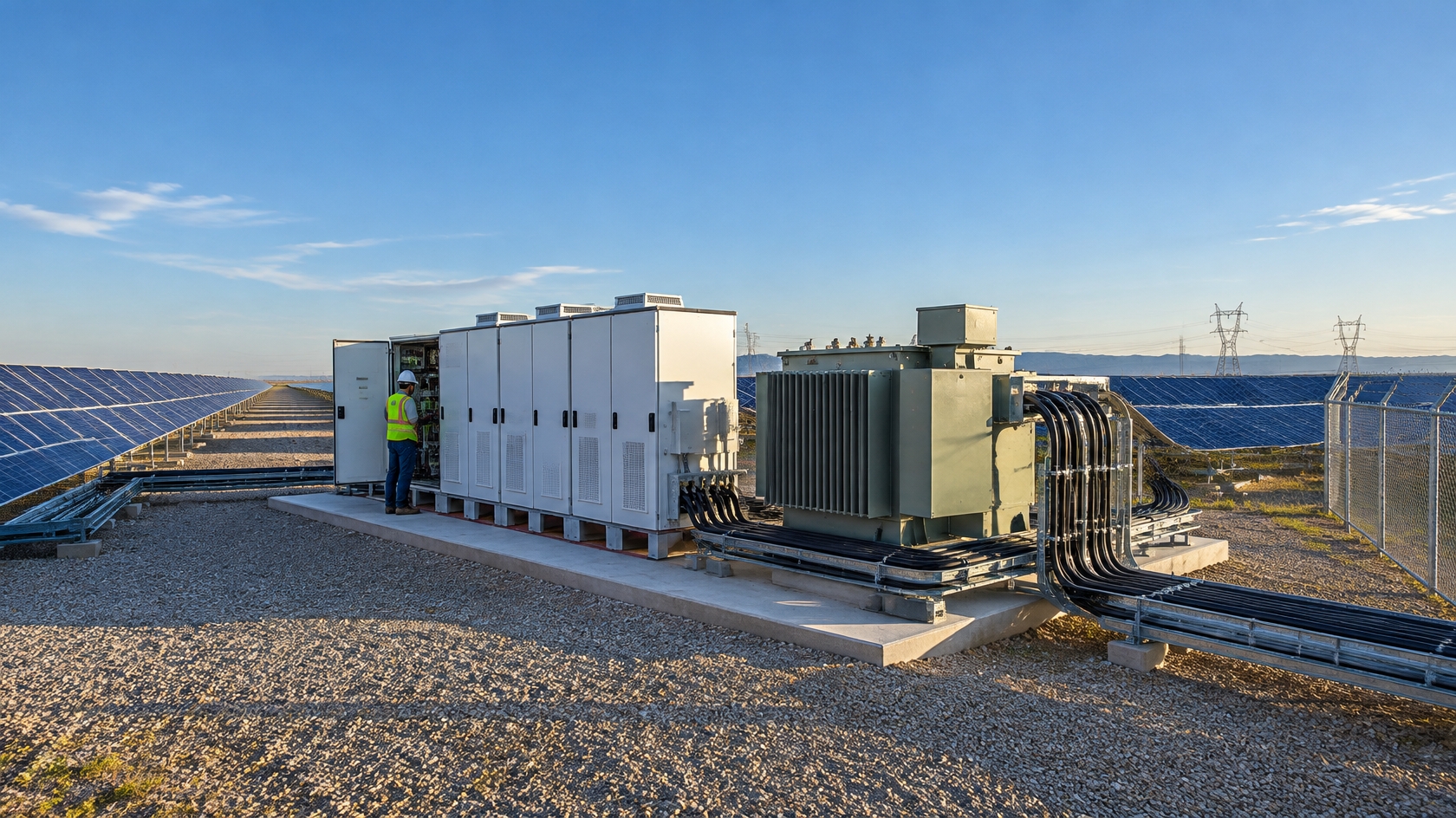
Solar projects fail at the wiring, not the panels. The key components of balance of system in solar account for 50-60% of total project costs, yet they receive far less attention than the modules themselves. Getting these components right determines whether a system performs for decades or underperforms from day one.
Introduction
Solar panels generate electricity. Everything else in the system makes that electricity usable. That "everything else" is the Balance of System, or BoS, and it covers a wide range of electrical and structural components that connect, protect and distribute power.
BoS decisions shape project cost, safety, compliance and long-term performance. A poorly specified disconnect or an undersized combiner box can create losses that compound over a 25-year system life.
The stakes are real. Understanding each component and how they work together helps project teams, installers and buyers make smarter decisions from design through commissioning.
What Is Balance of System in Solar
Balance of System (BoS) refers to every component in a solar installation beyond the panels themselves. This includes inverters, wiring, racking, combiners, disconnects and monitoring equipment. According to Beny Solar using NREL/IRENA 2025 data, BoS components make up 50-60% of total solar project costs.
Key BoS categories include:
- Inverters: Convert DC power from panels into usable AC power for homes and the grid
- Mounting and racking: Structural systems that hold panels in place on roofs or ground
- Wiring and conduit: Conductors and pathways that carry current between components
- Combiner boxes: Aggregate output from multiple panel strings before the inverter
- Disconnect switches: Safety devices that isolate the system during emergencies or maintenance
- Monitoring systems: Track production, performance and fault conditions in real time
Solar Inverters: The Heart of Every BoS
The inverter is the most critical active component in any solar installation. It converts direct current from the panels into alternating current for building loads or grid export. The global solar inverter market was valued at USD $21.30 billion in 2025 and is projected to reach $39.54 billion by 2034.
String Inverters vs. Microinverters
String inverters connect a series of panels into one conversion unit. They're cost-effective for simple roof layouts with consistent sun exposure. Modern string inverters achieve 97-98% efficiency, per Surge PV.
Microinverters attach to each panel individually. They handle shading and orientation differences better than string designs. According to Fortune Business Insights, the microinverter segment is projected to grow at the fastest rate, at 7.96% CAGR through 2031.
Rapid Shutdown Requirements in the US
NEC 690.12 requires that conductors outside the array boundary drop below 30 volts within 30 seconds of initiating shutdown, per Greenlancer. This protects first responders during fires or emergencies. Most modern inverters and module-level power electronics include rapid shutdown compliance as a standard feature. Installers must verify that every component in the shutdown path meets the requirement before commissioning.
Mounting and Racking: Structural Foundation of Solar
Racking holds panels at the correct angle, resists wind and snow loads, and must last as long as the system itself. The U.S. Solar PV Mounting Systems Market was valued at USD $10.75 billion in 2025 and is expected to reach $18.23 billion by 2035.
Roof Penetrations and Waterproofing
Every roof-mounted system creates penetration points where hardware anchors into the structure. These points must be sealed correctly to prevent water intrusion. Flashing kits, rubber boots and sealant compounds are standard, but installation quality varies. Equipment costs for mounting systems represent approximately 3-7% of a typical residential project's total cost, per DOE Solar Cost Benchmarks.
Poor waterproofing creates warranty disputes and structural damage that far exceed the cost of doing it right the first time.
Wiring, Conduit, and Combiner Boxes
Wiring and conduit carry current between every component in the system. Poor cable selection can waste 1% to 3% of generated energy as heat through resistive losses, per PV Farm. Over a 25-year plant life, that loss becomes a significant LCOE impact.
Key wiring and combiner considerations include:
- Conductor material: Copper-based conductors hold an estimated 61.4% share of DC wiring revenue in 2025, per the DC Solar Cable Market Report, preferred for electrical performance and durability
- Conduit costs: PV copper wire runs $0.50-$1.50 per foot and conduit runs $1.00-$3.00 per foot, per NREL benchmarks
- Combiner boxes: The global solar combiner boxes market was valued at $1.8 billion in 2025, projected to reach $3.9 billion by 2034
- String aggregation: A typical 10 MW utility-scale installation may deploy 80 to 150 combiner boxes, each aggregating 8 to 32 PV strings
Disconnect Switches and Safety Devices
Disconnect switches are not optional. NEC Article 690.13 mandates that all photovoltaic systems include a means to disconnect all ungrounded conductors from all power sources, per Solar Permit Solutions. This applies to both DC and AC sides of the system.
Sizing matters as much as placement. Disconnect switches must be rated for continuous current equal to or greater than 125% of maximum circuit current under NEC 690.8. In cold climates, open-circuit voltage can reach 750V for a nominal 600V system, per sinobreaker.com.
A 2024 analysis of over 100,000 renewable energy systems found wiring and connector issues in 83% of projects, with 74% of critical safety issues related to DC power distribution, per HelioVolta via PV-Tech. Proper disconnect specification and installation directly reduces that risk.
How BoS Components Function as a System
No BoS component operates in isolation. Each one affects the performance of every other. A voltage drop in the wiring reduces inverter input. A poorly rated combiner creates a bottleneck. A missing shutdown device creates a compliance failure.
How BoS Components Work Together
DC power flows from panels through wiring into combiner boxes, then to the inverter for conversion. AC power exits the inverter through additional wiring, past the disconnect, and into the building panel or grid connection point. According to HelioVolta via PV-Tech, quality issues in BoS can raise a PV system's levelized cost of energy by more than 20%.
On a typical utility-scale site, a 4% voltage drop design saved $2 million upfront in smaller cables but burned through $40 million in lost energy over the project lifetime, per PV Farm.
Monitoring Systems and Data Loggers
Monitoring systems track production, identify underperforming strings and flag faults before they become failures. Data loggers collect interval data from inverters, meters and sensors. According to Lawrence Berkeley National Laboratory, module-level power electronics were used in 87% of residential and 73% of small non-residential systems in 2025.
These devices provide granular performance data that generic system-level monitoring can't match. Real-time visibility supports faster troubleshooting and better long-term performance.
Real-World BoS Example: A Typical US Residential Solar Setup
A typical U.S. residential installation illustrates how BoS components come together in practice. The median residential solar system size in 2025 is 7.7 kW, per Lawrence Berkeley National Laboratory. The DOE models an 8 kWdc system with 20 modules at 400W each.
A standard residential BoS package includes:
- String inverter or microinverters: Sized to match array output and local utility interconnection rules
- Racking system: Roof-mounted fixed-tilt hardware with flashed penetrations and bonding hardware
- DC wiring and conduit: Runs from each string to the combiner or directly to the inverter
- AC disconnect: Mounted near the utility meter per NEC and local AHJ requirements
- Production meter: Tracks system output for incentive programs and performance monitoring
- Rapid shutdown device: Required by NEC 690.12 for all rooftop installations
The national average installed cost in 2025 is $2.50-$3.50 per watt before incentives, per SolarReviews.
Battery Storage as an Optional BoS Component
Battery storage has moved from optional upgrade to near-standard component in many markets. Battery storage was paired with 37% of new U.S. residential solar installations in 2025, up from 25% in 2024, per PV Magazine USA and LBNL.
"The U.S. energy storage industry installed a record-shattering 57.6 GWh of new capacity in 2025, the largest single year of new battery capacity additions on record." - SEIA
The median battery storage capacity for new residential solar-plus-storage systems in 2025 remained at 13.5 kWh, per LBNL. Adding storage changes the BoS scope significantly.
Grid-Tied vs. Off-Grid BoS Differences
Grid-tied systems use a simpler BoS configuration. The inverter connects directly to the utility, and the disconnect allows safe isolation. Off-grid systems require battery banks, charge controllers, additional disconnect points and more complex wiring.
The average global price of a turnkey battery energy storage system fell to US$117/kWh in 2025, down from $165/kWh in 2024. That cost reduction is making off-grid and hybrid configurations more viable for residential and commercial projects.
Conclusion
The key components of balance of system in solar determine how well a project performs, how safely it operates and how much it costs over its lifetime. Panels get the attention, but BoS decisions drive real-world outcomes. Every component from the racking to the disconnect plays a defined role in system reliability.
Choosing the right equipment, specifying it correctly and installing it to code protects the investment for decades. Working with experienced electrical engineering and manufacturing partners helps reduce field risk, simplify commissioning and support long-term performance across residential, commercial and utility-scale projects.
Frequently Asked Questions
How much do balance of system components cost in the United States?
For a typical U.S. residential installation, BoS hardware and related soft costs account for 40-60% of total project expenses, per NREL. At utility scale, BoS hardware represents approximately 26% of total CAPEX.
In a federal cost breakdown of a 12 kW residential system, inverters add roughly 10%, racking adds 3% and electrical wiring adds 9% of total installed cost, with labor and permitting making up the remainder.
How reliable is solar BoS equipment in the United States?
Reliability varies significantly by installation quality. Nearly 70% of U.S. solar EPCs failed to meet baseline quality standards, per HelioVolta's 2025 SolarGrade PV Health Report, with 85% of analyzed projects containing major issues requiring urgent corrective action. Specifying components to NEC requirements, using listed equipment and working with experienced installers reduces failure risk and supports better long-term system availability.
What efficiency losses should I expect from BoS components?
Typical system-level efficiency losses across BoS components are measurable and manageable. DC wiring losses run 1-3%, inverter conversion losses run 2-4% and transformer losses add 0.5-1.5%, per SolarTech Online using NREL benchmarks. Soiling adds another 1-5% depending on location and cleaning frequency. Proper component sizing and quality installation keep cumulative losses toward the lower end of these ranges.
How does battery storage compare to a basic grid-tied BoS setup?
A basic grid-tied BoS is simpler and less expensive. Adding battery storage introduces charge controllers, additional disconnect points and more complex wiring.
The global BESS market grew nearly 50% year-on-year in 2025, per Benchmark Mineral Intelligence, driven by falling prices and rising grid uncertainty. For most residential buyers, the added BoS complexity is offset by backup power capability and greater energy independence.
What are the NEC requirements for solar disconnect switches?
NEC Article 690.13 requires all PV systems to include a means to disconnect all ungrounded conductors from every power source. Disconnects must be rated for continuous current at least 125% of maximum circuit current under NEC 690.8.
Systems must also meet NEC 690.12 rapid shutdown requirements, which mandate that conductors outside the array boundary drop below 30 volts within 30 seconds of initiating shutdown. Local AHJ requirements may add further specifications beyond the NEC baseline.
