Accepting a panel without checking its credentials is one of the fastest ways to fail an inspection, void insurance coverage, or create a serious safety hazard. In the United States, 130 workers died from electrical exposure in 2024. A proper checklist for evaluating UL certified electrical panels protects your project before equipment ever reaches the field.
Introduction
UL certification is not a formality. It is a compliance requirement backed by federal regulation, enforced by inspectors, and scrutinized by insurers after every incident. NEC Article 409 and OSHA 29 CFR 1910.303 both require electrical equipment to be listed or labeled by a Nationally Recognized Testing Laboratory (NRTL), with no exemptions.
Getting this right means the difference between a smooth commissioning and a costly field rejection. A panel that looks correct on the outside can still carry the wrong Short-Circuit Current Rating, missing markings, or components that void the assembly's listed status. This guide gives operations leaders, engineers, and procurement teams a structured evaluation framework covering the standards that apply, the testing requirements behind them, and the red flags that signal non-compliance before a panel is accepted.
What Makes an Electrical Panel UL Certified
UL certification means a Nationally Recognized Testing Laboratory has evaluated a panel against a defined safety standard and confirmed it meets every applicable requirement. The process is not self-declared. It involves documented testing, shop audits, and ongoing follow-up inspections.
Key facts about what certification actually requires:
- NRTL evaluation: An accredited lab, not the manufacturer, must conduct or witness the testing and issue the listing.
- Standard alignment: The panel must be built to a specific UL standard relevant to its voltage, application, and installation environment.
- Nameplate marking: The finished assembly must carry a compliant UL mark with the correct product identity and control number.
- Shop program compliance: For UL 508A, the fabricating shop must operate under a certified program with quarterly unannounced audits.
- Ongoing listing maintenance: Certification is not permanent. It requires continued compliance through follow-up inspections and documented procedures.
Which UL Standards Apply to Your Panel Type
Not every panel falls under the same standard. Voltage range, installation environment, and application type all determine which UL standard governs the build. Applying the wrong standard, or none at all, creates compliance gaps that inspectors will find.
UL 508A: Industrial Control Panels
UL 508A is the primary standard for industrial control panels operating at 1,000 volts or less in ordinary locations. It covers ambient temperatures between 5°C and 40°C and requires installation in accordance with NFPA 70. On June 26, 2025, UL 508A (Edition 3) was designated an American National Standard by ANSI, confirming its development through a balanced, open consensus process. This is the standard most industrial control panels in the U.S. are built to.
UL 891: Switchboards and Power Distribution Panels
UL 891 governs dead-front switchboards and covers assemblies rated up to 4,000A with SCCR ratings up to 100kA. It applies to power distribution applications where higher current capacity and more complex bus arrangements are involved. Projects that include switchboards, recombiners, or mini power centers will typically require UL 891 compliance alongside or instead of UL 508A, depending on the assembly type and end-use application.
Other Standards for Specialized Applications
Hazardous locations require UL 698A, which covers industrial control panels in classified environments. UL 1203 applies to explosion-proof and dust-ignition-proof equipment, with a Standards Update Notice effective July 10, 2025. For Power Control Systems, UL 3141 is now required under the 2026 National Electrical Code. As of late 2025, nearly half the states had adopted the 2023 NEC, while others remain on earlier editions.
Core Requirements UL Testing Demands of Control Panels
UL testing goes beyond visual inspection. It confirms that a panel can perform safely under fault conditions, that its components are rated correctly, and that its markings give field teams the information they need. Three areas carry the most weight during evaluation.
SCCR: Why It Is the First Thing to Check
Short-Circuit Current Rating (SCCR) is mandatory on all industrial control panel nameplates per NEC Sections 409.110, 670.3(A), and 440.4(B). Most panels carry a default rating of only 5,000A, which frequently fails to meet site requirements when available fault current is higher. A panel labeled at 10 kA installed at a site with 65 kA available fault current is a direct NEC 409.22 violation. Verify the SCCR against the site's available fault current before accepting any panel.
Enclosure Rating and Component Layout
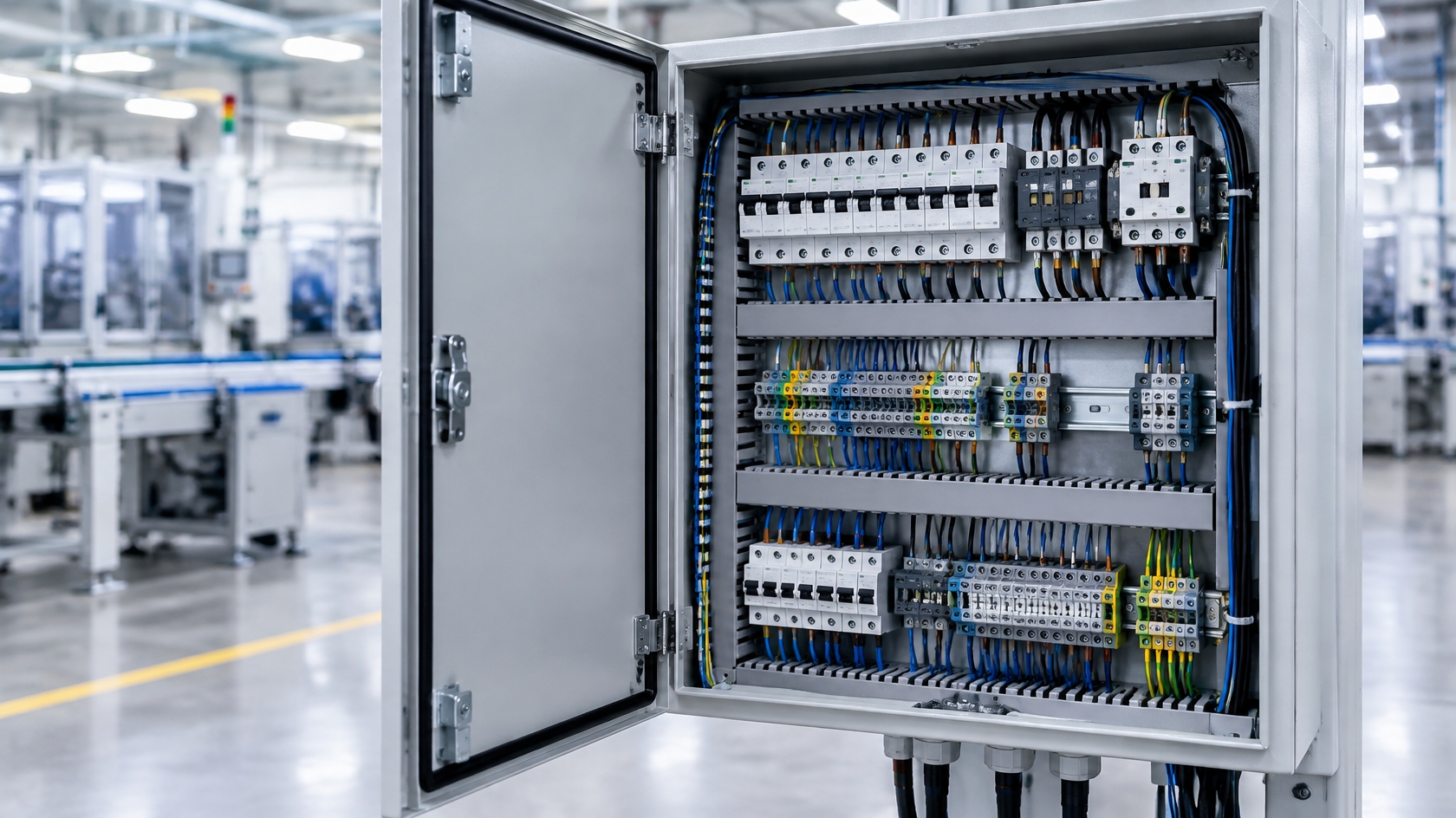
The enclosure must carry the correct NEMA or IP rating for its installation environment. Component layout inside the panel must meet spacing, clearance, and segregation requirements defined by the applicable standard. OSHA also requires electrical panels to maintain minimum clearance of 36 inches in depth, 30 inches in width, and 78 inches in height in front of the equipment. These dimensions are among the most commonly cited violations during inspections.
Nameplate and Marking Requirements
The nameplate must include the UL mark, product identity, control number, voltage rating, current rating, and SCCR. The June 2025 revision to UL 508A also introduced SCCR requirements for one-port surge protective devices and set control circuit voltage limits at 120 Vac and 250 Vdc. Missing or incorrect nameplate data is not a minor paperwork issue. It is grounds for rejection by the Authority Having Jurisdiction (AHJ).
The Evaluation Checklist: What to Inspect Before Accepting a Panel
A structured checklist for evaluating UL certified electrical panels covers more than the label on the door. It includes the documentation package, the physical assembly, and independent verification of the listing itself.
Documentation Package: What to Demand in Writing
Documentation is the foundation of a defensible acceptance process. Without it, you cannot verify compliance, support an insurance claim, or troubleshoot a field issue. For traceability, IEC 61439 compliance requires a Technical File that must be retained for at least ten years after the last date of manufacture.
Demand these documents before accepting any panel:
- Electrical drawings and schematics: Stamped, revision-controlled, and matching the as-built assembly.
- Bill of materials: Listing every component with manufacturer part numbers and UL listing status.
- SCCR calculation or documentation: Showing how the panel's SCCR was determined.
- Test reports: Including dielectric withstand (HIPOT) results and any factory acceptance test records.
- UL shop certification evidence: Confirming the fabricating facility holds an active UL 508A shop listing.
How to Verify a UL Listing Online
Do not rely on the label alone. UL Product iQ is UL Solutions' official online database for verifying genuine certifications. Search by the control number printed on the panel's nameplate. A genuine UL mark must contain four elements: the UL symbol in a circle, the word "LISTED," the product identity, and a unique four-character alphanumeric control number. If the control number does not return a valid result in UL Product iQ, treat the panel as unlisted until confirmed otherwise.
Red Flags That Signal a Non-Compliant Panel
Some compliance failures are obvious. Others require a closer look. Knowing what to watch for protects your project from costly rejections and safety incidents.
Common red flags include:
- Incorrect UL mark format: "APPROVED" or "PENDING" instead of "LISTED," or "UL" letters side-by-side rather than staggered in the official mark.
- Missing SCCR on the nameplate: Any panel without a clearly marked SCCR is non-compliant under NEC 409.110.
- Substituted components: Supplemental breakers used in place of required branch circuit protection, or components not verified for combined SCCR.
- No documentation package: A supplier unable to provide drawings, BOM, or shop certification evidence is a serious warning sign.
- Counterfeit marks: An estimated $300 to $400 million in counterfeit electrical products enter the U.S. each year. Verify every mark independently.
"85% of Federal Pacific Electric double-pole breakers failed UL test criteria." - Inspectapedia
UL Listed vs UL Recognized: The Difference That Changes Your Checklist
These two marks look similar but carry very different meanings. Confusing them is one of the most common compliance errors in panel evaluation.
UL Listed means a complete, standalone product has been tested for all relevant safety aspects and is certified for direct field installation. UL Recognized means a component has been evaluated for safety only for use inside a larger listed assembly. It carries a backward "UR" mark, not the circular UL Listed mark.
A UL Recognized component installed outside a certified assembly is treated as unlisted equipment. The AHJ will reject it because it does not satisfy NEC 110.3(B) requirements for finished, field-installed equipment. A finished assembly made entirely from UL Recognized components does not automatically count as UL Listed. The finished assembly must be separately evaluated as a complete product. Under UL 508A, power circuit components such as circuit breakers and contactors must be UL Listed, while control circuit components may be UL Recognized, but only under their specific conditions of acceptability.
Conclusion
Evaluating a UL certified electrical panel requires more than checking a label. It demands verification of the applicable standard, confirmation of SCCR against site conditions, a complete documentation package, and independent listing verification through UL Product iQ. Each step in the checklist exists because a gap at any point can result in inspection failure, insurance exposure, or a safety incident.
ASG Power supports this process with standards-driven manufacturing, in-house testing and inspection, and documentation aligned to field-ready delivery. Equipment built under a certified shop program arrives with the traceability and marking that AHJs and project teams need to move forward with confidence.
Frequently Asked Questions
How much does UL 508A panel certification cost in the United States?
Non-listed panels requiring NRTL field evaluation typically cost $2,000 to $8,000 per panel and add weeks to project timelines. UL 508A certified fabrication generally adds only 10 to 20% to panel cost compared to non-UL fabrication. That premium protects against OSHA citations up to $16,550 per serious violation, insurance claim denials, and arc flash incident costs that can reach $500,000 or more.
Is UL 508A certification federally mandated across the United States?
There is no single blanket federal law making UL 508A mandatory by name. However, OSHA 29 CFR 1910.303 requires all electrical equipment to be approved by an NRTL, and NEC Article 409 requires SCCR marking on industrial control panels. Most AHJs and insurers require listed equipment or a field evaluation, making UL 508A certification a de facto requirement across commercial and industrial projects nationwide.
What is HIPOT testing and is it required for UL certified panels?
HIPOT (dielectric withstand) testing verifies that insulation can safely isolate live circuits under high-voltage stress. One UL dielectric withstand test requires a product to withstand 1,500 volts AC for one minute. It is a standard part of the factory acceptance testing process for certified panels and confirms that wiring, insulation, and component spacing meet the safety requirements of the applicable standard before the panel ships.
What is the difference between UL 508A and NFPA 79?
UL 508A governs the design and construction of the control panel itself, while NFPA 79 governs the electrical equipment of industrial machinery, both inside and outside the panel enclosure. Both standards may apply simultaneously to machine-mounted panels. A panel builder working on machinery applications should confirm which standards the AHJ and end user require, since satisfying one does not automatically satisfy the other.
How long does it take a panel shop to achieve UL 508A certification?
For a panel shop, the certification process typically runs 2 to 4 months, followed by quarterly unannounced follow-up inspections required to maintain the listing. Annual follow-up inspection fees generally run $2,000 to $5,000 per year. Shops that maintain active certification can build and mark panels under the UL 508A program without requiring individual panel-by-panel NRTL evaluation, which significantly reduces project timelines.
