
Benefits of Prefabricated Electrical Buildings for Industries
November 24th, 2026
5 min read
By ASG Power
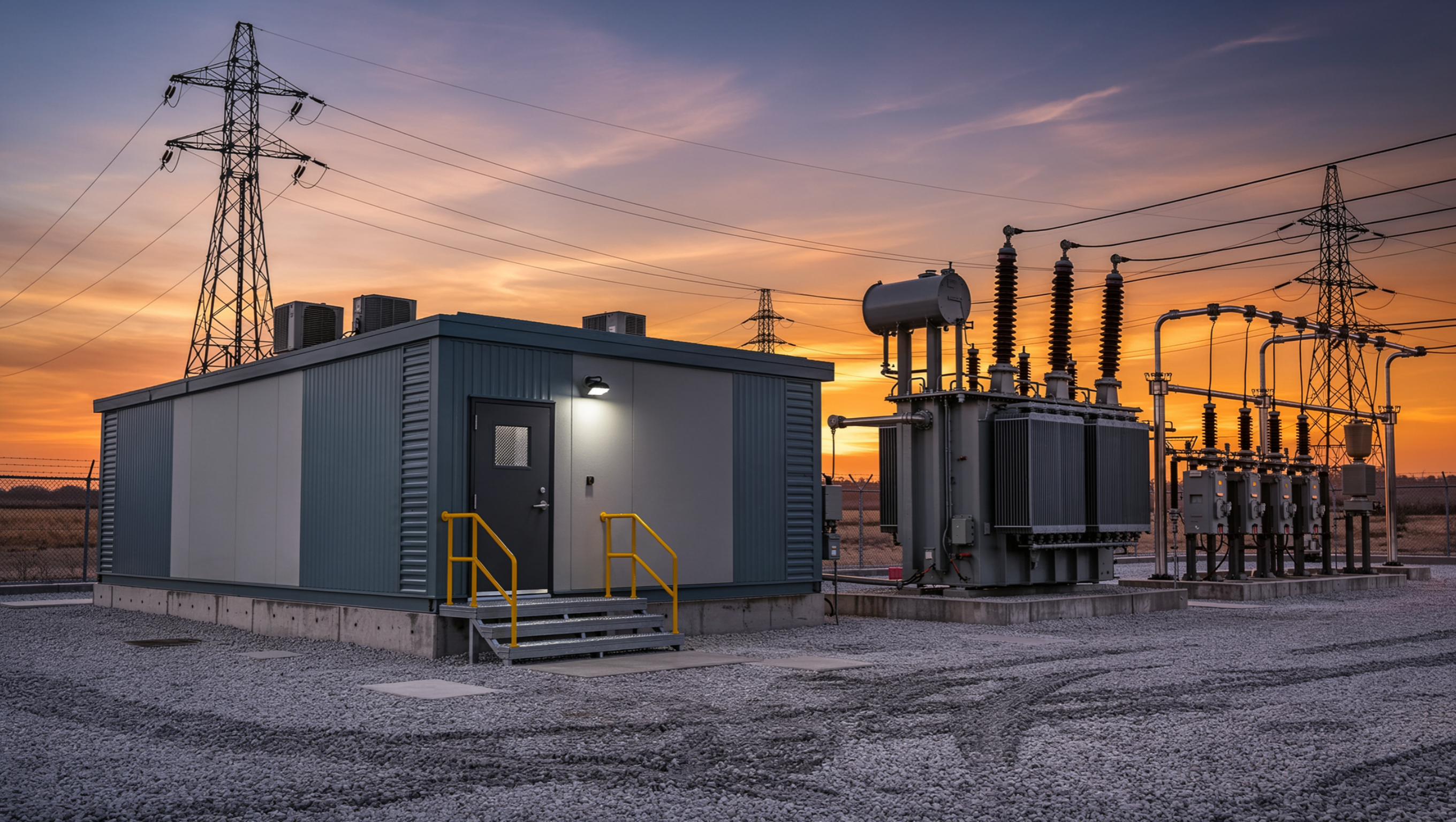
Industrial projects lose weeks, sometimes months, to site-built electrical construction delays. The benefits of prefabricated electrical buildings for industries are reshaping how US project teams plan, build and commission power infrastructure. Factory-built solutions are changing the economics of electrical deployment.
Introduction
Prefabricated electrical buildings, often called E-Houses or Power Distribution Centers, are factory-integrated enclosures that house switchgear, transformers, motor control centers and automation controls. They arrive at the job site ready for connection rather than requiring months of sequential field assembly.
The shift toward prefabrication reflects real pressure on project teams. Labor shortages, tighter schedules and rising field costs are pushing industrial buyers toward solutions that move more production into controlled manufacturing environments. Power projects move more smoothly when equipment is connected safely, controlled reliably and delivered efficiently, making prefabricated electrical buildings a compelling choice for utilities, manufacturers, data centers and energy developers across the United States.
What Are Prefabricated Electrical Buildings?
A prefabricated electrical building is a fully customizable, factory-integrated enclosure housing electrical control and power distribution equipment. According to Eaton, these structures typically include switchgear, transformers, MCCs, VFDs, UPS systems, HVAC and automation controls. The broader Prefabricated E-House Systems Market reached USD 6.4 billion in 2025, projected to reach USD 14.0 billion by 2036.
Common equipment integrated into these buildings includes:
- Switchgear: Handles fault protection and circuit isolation across the distribution system
- Transformers: Step voltage up or down to match load requirements at the facility
- Motor Control Centers (MCCs): Centralize motor starting, protection and control functions
- VFDs and UPS Systems: Manage variable-speed drives and provide backup power continuity
- HVAC and Thermal Management: Protect sensitive electrical components in harsh environments
Why Prefabricated Electrical Buildings Outperform Site-Built Alternatives
Factory-built electrical buildings consistently outperform site-built alternatives on quality, safety and schedule. According to McKinsey, modular construction can deliver projects 20 to 50 percent faster than traditional methods, with potential cost savings of up to 20 percent.
Quality Control Built Into the Process
Factory assembly shifts complex work into a controlled environment. A McGraw-Hill report found 90% of prefabrication users reported improved quality, with at least 80% reporting reduced waste and improved cost predictability compared to traditional site-built methods.
"90% of prefabrication users reported improved quality, with at least 80% reporting reduced waste and improved cost predictability compared to traditional site-built methods." - msuite.com
ASG Power supports this model by building, testing and inspecting equipment before it leaves the facility. In-house quality assurance, documented inspection steps and Factory Acceptance Testing help make sure equipment arrives field-ready rather than requiring rework after delivery.
Safety Advantages Over Site Construction
Moving electrical assembly off the job site reduces worker exposure to weather, congestion and uncontrolled conditions. Factory floors follow consistent safety protocols that are harder to maintain across rotating field crews.
ABB and Wieland Electric's plug-and-play prefabricated raceway system, launched in January 2025, reduces on-site electrical installation time by up to 70 percent. Fewer field wiring steps mean fewer opportunities for installation errors and fewer safety exposures during commissioning.
Cost and Time Savings That Drive Industrial Adoption
The financial case for prefabricated electrical buildings is well documented. According to the U.S. DOE, 91% of General Contractors and Construction Managers saw cost reductions in modular projects, with 53% seeing greater than 10% reduction in total project costs.
The savings come from multiple directions:
- Reduced labor costs: A real casino/hotel project using prefabrication used 25% less field labor and cut nearly two months off installation time
- Lower build costs: Eaton's Modular Integrated Transportable Substation (MITS) builds and commissions 40% cheaper than a traditional substation
- Faster commissioning: Eaton MITS requires only 30 days to build, install and commission, versus 109 days for a conventional substation
- Relocation flexibility: MITS delivers 50% savings on future relocation costs, a key advantage for industrial sites that evolve over time
- Space efficiency: The same platform achieves 25% savings in space compared to traditional substation footprints
Modular Buildings and Space Efficiency
Prefabricated electrical buildings consolidate power, controls and network communications within one compact enclosure. Interstates reports that a modular E-House solution can save approximately 15% on overall project costs through this consolidation approach.
Space savings matter in industrial settings where footprint drives civil and structural costs. Smaller enclosures reduce foundation requirements, conduit runs and cable quantities, all of which compound into meaningful schedule and cost reductions across a full project.
Key Components of a Successful Prefabricated Electrical Building
A well-designed prefabricated electrical building integrates multiple systems into a single, tested assembly. DataIntelo reports that transformers represent 28.4% of integrated components, followed by switchgear at 22.6%, bus bars at 18.9% and HVAC/thermal management at 15.2%.
Technology Integration and Automation
Modern prefabricated electrical buildings incorporate automation controls, energy management systems and remote monitoring capabilities. These systems support safer startup, easier troubleshooting and reliable handoff to operations teams.
ASG Power supports technology integration by aligning controls, documentation and build execution so equipment arrives ready for long-term operation. Standards-driven inspection and testing, including Factory Acceptance Testing when required, support field-ready delivery and reduce commissioning surprises.
Collaboration and Communication
Successful prefabricated electrical buildings depend on close coordination between engineering, manufacturing and field teams. Design-to-build alignment reduces scope gaps and revision cycles that add cost and delay.
ASG Power works as an extension of the project team, supporting fewer handoffs from design through delivery. Documented inspection steps, complete drawings and bill-of-materials traceability help field teams understand exactly what they're receiving before equipment arrives on site.
Industries Using Prefabricated Electrical Buildings Across the US
Prefabricated electrical buildings serve a broad range of US industries. North America holds the dominant share of the global market, valued at USD 2.1 billion in 2025 and projected to reach USD 4.7 billion by 2033. Key sectors driving adoption include:
- Utilities and grid modernization: PG&E's MPAC program installs 10 to 15 prefabricated substation control buildings per year as part of ongoing grid expansion
- Oil and gas: In one documented case, modular leased units reduced setup time by 50% and saved over $2 million in initial costs
- Data centers: Industrial and institutional buildings including data centers captured 39.8% of the modular construction market in 2025
- Renewable energy: Solar, storage and hydrogen projects use prefabricated EBOS equipment to reduce onsite labor and shorten installation steps
- Manufacturing: The industrial application segment represented approximately 31.7% of total prefabricated substation demand in 2025
"91% of General Contractors and Construction Managers saw cost reductions in modular projects, with 53% seeing greater than 10% reduction in total project costs." - U.S. Department of Energy
Conclusion
Prefabricated electrical buildings give industrial project teams a practical path to faster schedules, lower field costs and more predictable commissioning outcomes. The evidence from utilities, oil and gas operators, data center developers and manufacturers consistently points in the same direction: factory-built solutions reduce risk and improve results.
For US project teams evaluating their next electrical infrastructure investment, the combination of controlled manufacturing, integrated testing and field-ready delivery makes prefabricated electrical buildings a strong foundation for long-term performance and cost control.
Frequently Asked Questions
How much do prefabricated electrical buildings cost in the United States?
Basic single-section E-Houses in the United States range from $50,000 to $150,000. Large or custom multi-room units with hurricane ratings, ballistic protection or advanced HVAC systems cost $200,000 to $500,000 or more per unit, according to Panel Built. Oilfield modular prefab builds typically run $260,000 to $360,000 compared to $350,000 to $480,000 for field construction, a 25 to 30 percent cost reduction.
Which US industries are adopting prefabricated electrical buildings fastest?
Utilities, data centers and oil and gas operations are leading adoption across the United States. Mordor Intelligence reports that industrial and institutional uses including data centers generated 42.78% of modular construction revenue in 2025. Utility programs like PG&E's MPAC initiative have installed over 130 prefabricated buildings over 20 years, demonstrating long-term confidence in the approach.
Can prefabricated electrical buildings operate in hazardous environments?
Yes. Prefabricated electrical buildings can be engineered to meet hazardous area classifications such as Class 1 Division 2, making them suitable for operation around flammable gases and volatile substances. This makes them a fit for oil and gas, chemical processing and other demanding industrial environments. HVAC and thermal management systems, which represent 15.2% of integrated components, provide essential protection across transformers, switchgear and controls.
How do prefabricated electrical buildings compare to traditional site-built construction?
Prefabricated buildings consistently outperform site-built alternatives on schedule, quality and waste reduction. The U.S. DOE reports modular construction reduces the overall weight of waste generated by up to 83%, with factory waste recycling rates reaching 75 to 90 percent compared to 20 to 30 percent for site construction. Factory completion before shipping reduces deployment timelines from months to weeks.
How long does it take to implement a prefabricated electrical building?
Implementation timelines vary by project scope, but factory-built E-Houses arrive with over 90% of production complete, according to 24 Market Reports. Combined startup and commissioning test plans mean assemblies arrive ready to manage anticipated normal and emergency operating conditions. Teams with existing site infrastructure and clear design packages typically see the fastest deployment, with commissioning measured in days rather than months.
